Deep Reinforcement learning (DRL) has achieved remarkable success in domains with well-defined reward
structures, such as Atari games and locomotion. In contrast, dexterous manipulation lacks general-purpose
reward formulations and typically depends on task-specific, handcrafted priors to guide hand–object
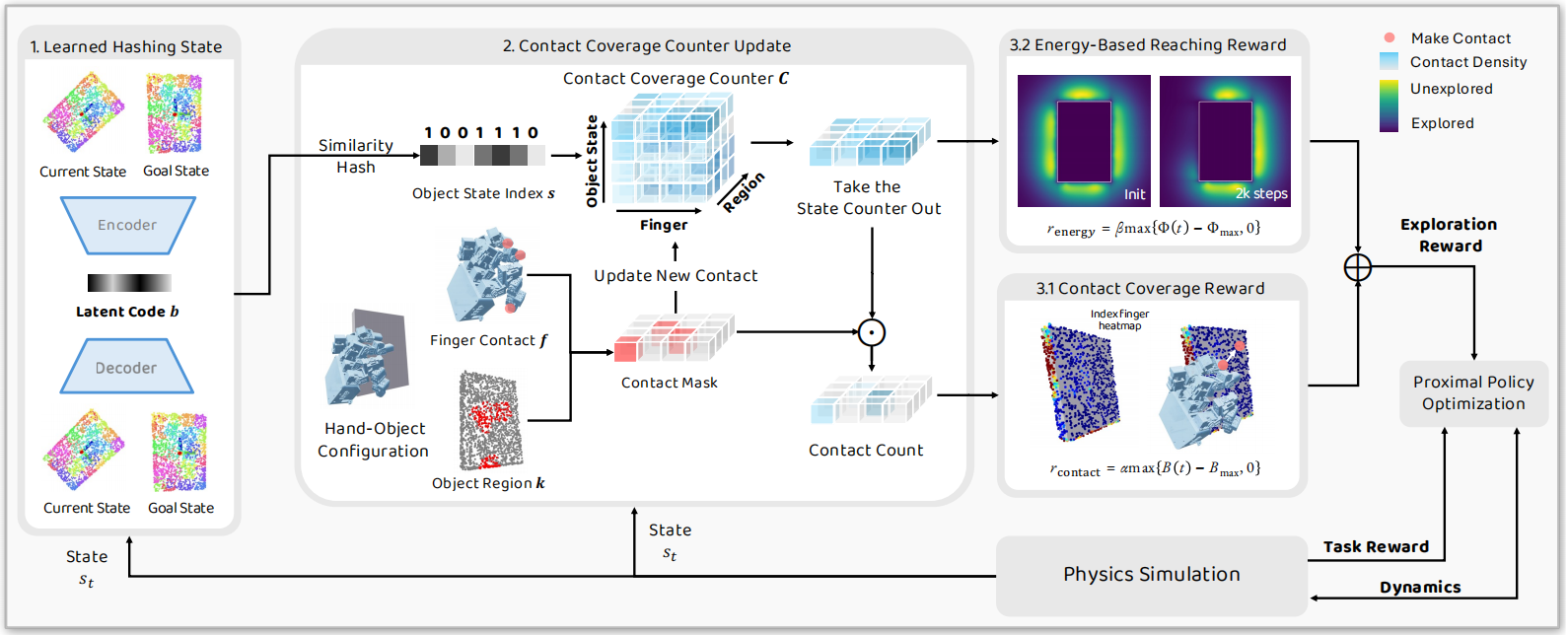
interactions. We propose Contact Coverage-Guided Exploration (CCGE), a general exploration method designed
for general-purpose dexterous manipulation tasks. CCGE represents contact state as the intersection between
object surface points and predefined hand keypoints, encouraging dexterous hands to discover diverse and
novel contact patterns, namely which fingers contact which object regions. It maintains a contact counter
conditioned on discretized object states obtained via learned hash codes, capturing how frequently each
finger interacts with different object regions. This counter is leveraged in two complementary ways: (1) to
assign a count-based contact coverage reward that promotes exploration of novel contact patterns, and (2) an
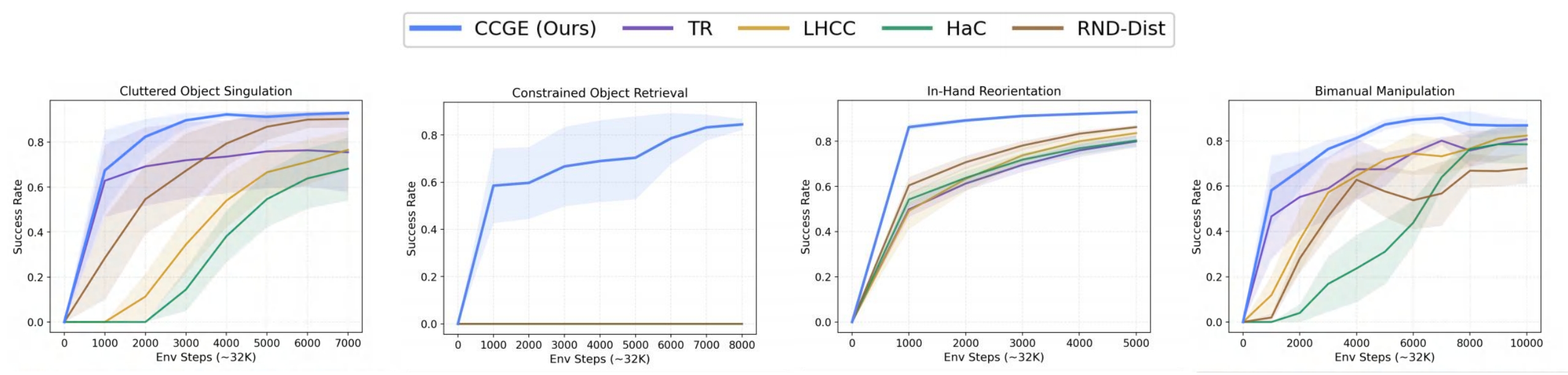
energy-based reaching reward that guides the agent toward under-explored contact regions. We evaluate CCGE
on a diverse set of dexterous manipulation tasks, including cluttered object singulation, constrained object
retrieval, in-hand reorientation, and bimanual manipulation. Experimental results show that CCGE
substantially improves training efficiency and success rates over existing exploration methods, and that the
contact patterns learned with CCGE transfer robustly to real-world robotic systems.
Deep Reinforcement learning (DRL) has achieved remarkable success in domains with well-defined reward
structures, such as Atari games and locomotion. In contrast, dexterous manipulation lacks general-purpose
reward formulations and typically depends on task-specific, handcrafted priors to guide hand–object
interactions. We propose Contact Coverage-Guided Exploration (CCGE), a general exploration method designed
for general-purpose dexterous manipulation tasks. CCGE represents contact state as the intersection between
object surface points and predefined hand keypoints, encouraging dexterous hands to discover diverse and
novel contact patterns, namely which fingers contact which object regions. It maintains a contact counter
conditioned on discretized object states obtained via learned hash codes, capturing how frequently each
finger interacts with different object regions. This counter is leveraged in two complementary ways: (1) to
assign a count-based contact coverage reward that promotes exploration of novel contact patterns, and (2) an
energy-based reaching reward that guides the agent toward under-explored contact regions. We evaluate CCGE
on a diverse set of dexterous manipulation tasks, including cluttered object singulation, constrained object
retrieval, in-hand reorientation, and bimanual manipulation. Experimental results show that CCGE
substantially improves training efficiency and success rates over existing exploration methods, and that the
contact patterns learned with CCGE transfer robustly to real-world robotic systems.